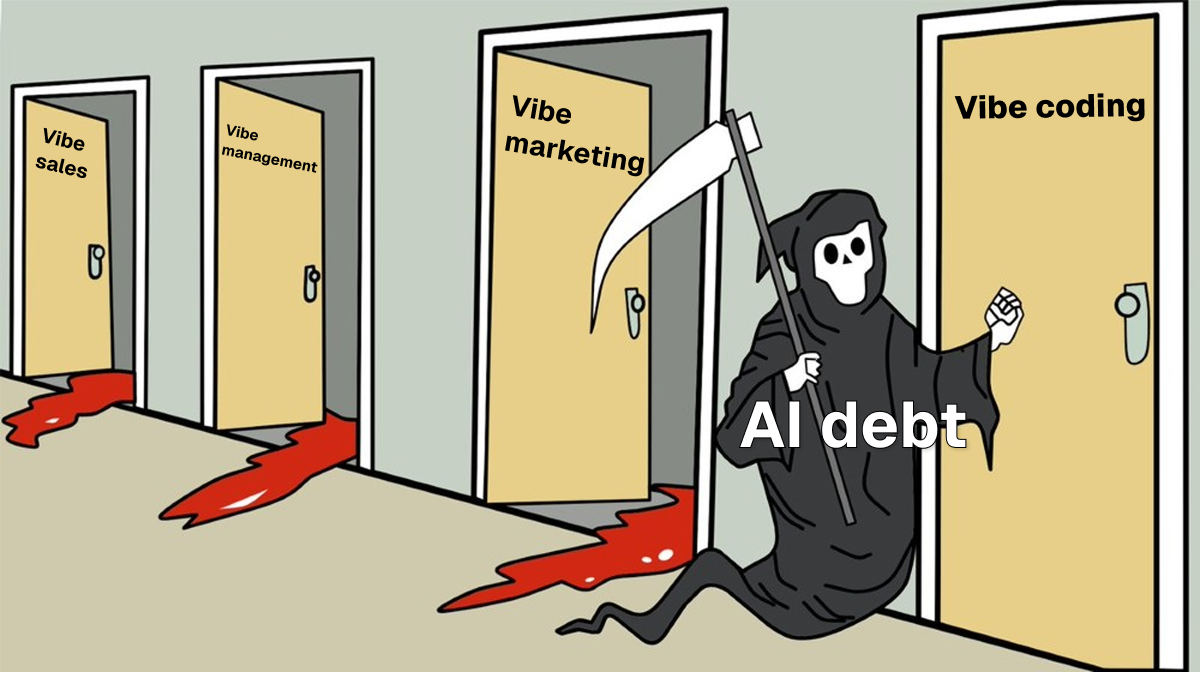
AI debt is knocking on your door
We've all decided that speed is the same as progress.
AI can write code, draft specs, prepare analyses, and generate strategies. Every week, there's a new tool, a new benchmark, a new "10x" claim. Productivity is up. Output is up. Everyone feels ahead.
But here's the thing: most teams aren't leveraging intelligence. They're just noise.
I'm seeing more and more cases where people accept AI output because it looks coherent. It's well-structured, detailed, and easy to understand. People even use another AI pass to "review" it. And that's where the scrutiny ends. The reasoning behind this rarely gets challenged.
AI is a force multiplier. That's pretty clear. What's not so clear is what it multiplies.
If you've got solid processes, real ownership, disciplined reviews, and architectural clarity, AI can really help to amplify that. You'll be able to move faster without losing your balance.
If you don't, AI amplifies the chaos. Weak requirements become confident-looking documents. Fragile architecture can turn into a bunch of code that's all syntactically correct, but not strategically aligned. Assumptions turn into artifacts. Everything looks so polished that it creates a strong illusion of control.
The dangerous part isn't the hallucinated facts. It's a misunderstanding that's been blown out of proportion.
Now add some volume. There are just so many artifacts to go through, and it's hard for people to really evaluate them. For organizations that are already struggling with alignment, this isn't an example of acceleration — it's more like compounding debt.
Even in a solo project, you can see the pattern. Yeah, AI definitely increases throughput. But honestly, the hard part was never typing code. It involves thinking about business logic, edge cases, system interactions, and long-term consequences. AI can generate answers. It doesn't take responsibility for systemic coherence.
Take a break from your usual standards for a few weeks and see what happens. Features conflict. The performance starts to suffer. Documentation is a bit slow. There are always exceptions to the rules. Nothing's obviously broken, but the system does become a bit fragile.
In tech, we all know about technical debt. It's an awkward situation, but at least it's visible and mostly contained within engineering.
AI debt is a whole other ballgame.
It's something that's present throughout the organization. Developers, product managers, analysts, legal teams — everyone's generating decisions and artifacts at scale. When you're under a deadline, it's better to be quick. And the cost of not really knowing something adds up without you even realizing it.
You won't notice it right away. That's the whole point.
When you're ready, you won't even be dealing with code issues. You'll be dealing with assumptions.
I'm not one of those people who don't believe in AI. I'd say don't go for blind scaling. If governance, review practices, and decision accountability don't evolve with the tools, the debt compounds faster than traditional technical debt ever did.
AI debt isn't just a bunch of hype. It's the likely result of increasing output without increasing judgment.
And most organizations are already collecting it.